

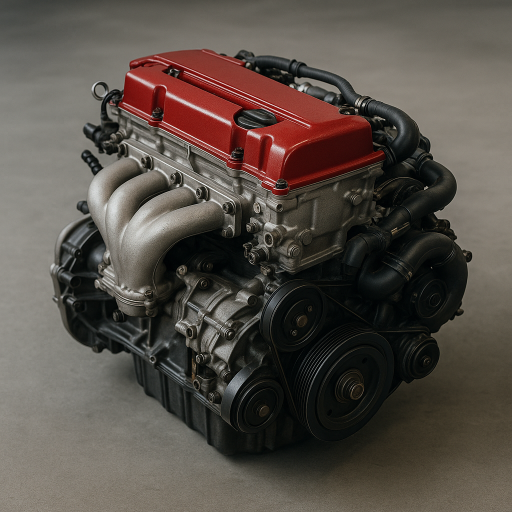
For enthusiasts who care about the way a car feels rather than simply how it looks on paper, engine choice shapes the entire driving experience. Power delivery, throttle response, rev character, durability under load, and aftermarket support all matter. That is why JDM engines continue to hold such a strong position in performance culture. They are not a shortcut to speed, nor are they automatically superior in every application, but in the right build they can offer a distinctive blend of engineering depth, tunability, and personality that is hard to ignore.
The appeal of JDM engines is rooted in more than nostalgia. Many of these powerplants are respected because they reward careful setup, accept thoughtful modifications, and deliver an involving character that drivers remember long after the numbers fade. For road cars, track projects, and swap builds alike, their value often lies in the balance they strike between performance ambition and mechanical substance.
Why JDM engines still matter in performance builds
The term JDM refers to vehicles and parts produced for the Japanese domestic market. In performance circles, it often points to engines that became desirable outside Japan because of their design, reputation, and compatibility with tuning culture. That reputation did not appear by accident. Many well-known Japanese engines earned respect through strong factory engineering, efficient packaging, and a willingness to perform well beyond stock form when properly maintained and upgraded.
What makes JDM engines especially attractive is the range of personalities they offer. Some are known for high-revving, naturally aspirated response. Others are prized for stout turbocharged architecture and broad torque potential. Some fit neatly into compact chassis, while others are chosen because they can anchor ambitious rear-wheel-drive performance projects. In practical terms, this variety gives builders more freedom to match an engine to the purpose of the car rather than forcing the car to adapt to an unsuitable powerplant.
There is also a cultural dimension that should not be dismissed. Performance enthusiasts are often drawn to engines with a clear identity. JDM engines tend to carry strong mechanical stories: engines associated with endurance, precise valvetrain design, turbo tuning, or exceptional rev willingness. That identity adds meaning to a build and often encourages owners to approach maintenance and modification with greater care.
The core performance benefits of JDM engines
The most obvious reason drivers seek out JDM engines is performance potential, but that phrase deserves a closer look. Raw horsepower is only one part of the equation. The best performance engines improve how a car behaves across the rev range and under real driving conditions.
- Responsive power delivery: Many respected Japanese engines are known for eager throttle response and usable power bands, giving the driver confidence in both street and circuit conditions.
- High-rev character: Certain naturally aspirated JDM engines are celebrated for their ability to rev cleanly and reward precise driving technique, making them engaging beyond simple acceleration runs.
- Turbo-friendly architecture: A number of turbocharged Japanese engines became popular because they respond well to supporting modifications when fuel, cooling, and management are handled properly.
- Efficient packaging: Compact dimensions can simplify swaps, improve weight distribution, or create more room for cooling and service access in a tight engine bay.
- Mechanical durability: Well-designed blocks, heads, and rotating assemblies often provide a strong starting point for reliable performance, provided the engine is sourced carefully and maintained correctly.
Another major advantage is the depth of knowledge surrounding these engines. Buyers researching JDM engines will quickly notice how much technical discussion exists around common swap paths, known weak points, parts compatibility, and tuning strategies. That shared knowledge does not guarantee success, but it reduces guesswork and helps owners make more informed decisions.
Tuning potential and aftermarket support
Performance value is rarely determined by an engine in untouched condition. The long-term appeal of JDM engines often comes from what they can become with the right supporting upgrades. An engine that accepts improved intake flow, better exhaust routing, stronger cooling, and proper calibration without losing its character is usually far more interesting than one that delivers a single impressive dyno figure but proves difficult to live with.
This is where JDM platforms tend to shine. Over time, many have benefited from extensive aftermarket development. Builders can often find solutions for engine management, turbo upgrades, fuel system improvements, mounts, wiring adaptations, clutch choices, and internal strengthening. More importantly, these upgrades are often supported by years of documented trial and error from experienced enthusiasts and workshops.
What that means in practice
- Easier planning: Well-known engine platforms usually have clearer upgrade paths, making it simpler to set realistic power goals.
- Better parts access: Common performance parts, service items, and swap components are often easier to identify and source.
- More predictable outcomes: Engines with established tuning history generally present fewer unknowns when modifications begin to stack up.
That said, tuning potential should never be confused with invincibility. Every engine has limits, and the strongest results usually come from balanced builds. Fuel quality, heat management, transmission strength, and drivetrain condition all play a role. JDM engines reward thoughtful engineering, not impulsive modification.
How JDM engines compare as swap candidates
One of the clearest reasons these engines remain relevant is their usefulness in swaps. A good swap candidate is not simply powerful; it must also make sense within the physical, mechanical, and financial constraints of the project. JDM engines often stand out because many offer a strong ratio of performance potential to size, weight, and aftermarket support.
| Factor | Why it matters | What to check |
|---|---|---|
| Engine dimensions | Determines fitment, clearance, and installation complexity | Crossmember position, firewall clearance, intake and exhaust routing |
| Transmission compatibility | Affects drivability, gearing, and total project cost | Bellhousing options, shifter placement, clutch setup |
| Wiring and electronics | Modern performance depends on clean integration | ECU support, sensor compatibility, loom condition |
| Cooling requirements | Heat control is essential for reliability | Radiator size, intercooling needs, airflow management |
| Parts support | Impacts maintenance and future upgrades | Availability of service parts, mounts, and tuning components |
When all of these elements line up, a JDM engine swap can transform a car in a way that feels cohesive rather than theatrical. The best swaps preserve balance. They do not merely add power; they sharpen the relationship between engine, chassis, and driver.
What buyers should consider before choosing a JDM engine
The strongest argument for JDM engines is also the reason buyers must be selective: they are sought after. Desirable engines can vary widely in condition, completeness, and provenance. A smart purchase starts with discipline, not excitement.
- Verify completeness: Sensors, manifolds, harnesses, igniters, and accessories can materially affect both cost and installation difficulty.
- Understand condition: Compression testing, leak-down testing where possible, visual inspection, and clear documentation matter more than optimistic claims.
- Plan the full budget: The engine itself is only one line item. Fluids, gaskets, mounts, cooling, fueling, wiring, labor, and tuning often define the real cost.
- Match the engine to the car: A balanced build is usually more satisfying than chasing the most famous engine available.
- Prioritize reliability alongside power: A slightly less ambitious setup with proper supporting hardware often delivers the better ownership experience.
It is also worth remembering that not every JDM engine is automatically special. Some are valuable because they fit a specific purpose exceptionally well. Others are better appreciated for their driving feel than their peak output. The right choice depends on whether the goal is daily usability, circuit endurance, responsive back-road driving, or a long-term enthusiast project.
Conclusion: performance with character, not just output
The enduring appeal of JDM engines comes down to a rare combination of strengths. They can offer compelling performance, rich tuning potential, strong community knowledge, and a sense of mechanical identity that elevates a build beyond simple specification chasing. In the right chassis, with the right planning, they deliver more than acceleration. They bring texture, response, and a sharper connection between driver and machine.
That is why JDM engines continue to matter. They are not magic, and they are not a substitute for careful engineering or proper maintenance. But for enthusiasts who value balanced performance and authentic driving character, they remain one of the most rewarding paths available. Choose well, build thoughtfully, and JDM engines can provide the kind of performance that feels as satisfying on the road as it does on paper.
——————-
Discover more on JDM engines contact us anytime:
Used Engines From Japan | HY JAPAN for jdm Engine and car
https://www.hy2japan.com/
Bucharest – București, Romania
Looking to rev up your ride with authentic JDM power? Discover HY JAPAN, your ultimate destination for high-quality used engines and cars straight from Japan. With a vast collection and competitive prices, we bring the heart of Japanese engineering to your doorstep. Explore our selection today and experience the thrill of true performance!